
Increasing Your Surface Area of Success

Photo by Pixabay on Pexels.com

I believe you can dramatically increase your odds of getting “lucky” by intentionally exposing yourself to as many upside opportunities as possible. Who do you think has a better chance to catch the record-setting fish – the person using a worm and a fishing pole, or the person who casts the biggest, widest net they can? The biggest payoffs in my life have happened when I combined two things: (1) casting a large net to increase the odds a big opportunity will appear, and (2) keeping an open mind to all possible opportunities. The strategy of utilizing both of these elements together is what I like to call the “Surface Area of Success”.

The concept is basically this: the more exposure, or surface area, that you have to people, ideas and opportunities, the more likely you are to be exposed to a situation that could lead to a large upside opportunity. In other words, most one-in-a-million opportunities will be found by the person who sees the largest volume of total opportunities. Then, if you keep an open mind and actively look for big opportunities without trying to control the outcomes, you will be positioned to find opportunities that you never could have planned for.

Below are two examples of times when I found myself in very competitive situations, and used the Surface Area of Success to increase my odds of finding an opportunity that otherwise would not have existed. 

The Elusive Real Estate Deal

Years ago when I was trying and failing to grow my real estate business, my biggest problem was supply and demand. There was a lack of supply – not many properties I could buy that were good investments. There was a ton of demand – many people with much more experience, cash and personal connections who were buying up all the good deals. Despite putting in a lot of hard work, I was getting my ass kicked. It quickly became clear to me that I needed to get creative to find an edge if I was going to succeed in this competitive market.

I started looking for unique ways to network with people and find properties for sale that nobody else knew about. What allowed me to finally close on a deal was changing my commuting route to and from my day job to drive through residential areas instead of the highway. I would pull over and call every “For Rent” or “For Sale” sign that I saw during my commute and try to buy the property (even the “For Rent” signs). Every single time the person on the other side of the phone declined my offer to purchase the property, but I always followed up by asking if they had any other properties that they would be willing to sell. I also provided a very clear description of who I was (a real estate investor trying to get started) and what I was looking for (off-market real estate deals). My theory here was if they were selling or renting one property, there was a chance they owned or had access to other properties that I could potentially purchase.

After months of doing this, I got “lucky”. One of the phone calls I made was to a real estate agent who told me that he did not have any properties to sell me now, but he did have a steady pipeline of off-market real estate leads and he would keep my name on his list. A few months later, we closed a great deal together on a package of seven properties. I also built connections through this deal that led me to my next several deals and suddenly I was on a roll.

You could look back at that phone call to a real estate agent and say that I got extremely lucky that I just happened to call someone who just happened to have a package of properties coming up for sale. But think about it… the more calls I made, the better the odds were that I would meet someone just like him. So even though it appears kind of lucky, it really wasn’t. My Surface Area of Success became so large that it was inevitable that some kind of good luck would break my way. I didn’t hit my goal because I made that one call all by itself. It was the process of calling many people for months that increased my odds of success to the point that I finally succeeded.

Finding Jobs That Don’t Exist

When I was in law school I used the principle of the Surface Area of Success to find my first job as an attorney during a very competitive job market. The financial crisis of 2007-2008 was in full force, and law firms drastically reduced the number of attorneys they were hiring. This made it very difficult to find a job. The market was so competitive the Wall Street Journal published an article about our law school class entitled “A Lament for the Class of 2010”. There were a lot of law students looking for jobs, many with better grades and better connections than I had, and it seemed as though all the good jobs were hiding somewhere under rocks.

So, I thought about ways that I could increase my exposure to possible opportunities. I pulled out the local bar directory which listed all attorneys in my city, and started contacting every attorney in the city, beginning in the “A’s”.  I didn’t have to get all the way to the “Z” section, but I was prepared to do so. One law firm happened to be in need of a part-time research assistant on some interesting matters, so he hired me on an hourly basis and it was a very good experience.  Another firm was looking for a full-time summer clerk, and indicated that they were planning to interview others for the position, but were glad I had saved them the trouble by reaching out first. With every phone call I made, I increased the odds that I would get a job in this competitive market. I wasn’t sure exactly what would happen, but by contacting so many possible sources for leads, I tipped the scales in my favor and I ended up with a full time job, a second part time job and quite a few connections that helped me find opportunities later in my career as well.

Like the elusive real estate deal example above, I believe I found these jobs because I reached enough people who could possibly generate a job opportunity for me that there really was no way that I wouldn’t have options. The Surface Area of Success was so big, that it was inevitable.

Embracing Uncertainty

Looking back on this, I realize that a big part of the reason this worked in both of these examples is that I kept an open mind to what a “success” looked like. In the past, I have tried to control what the outcome of a particular situation would be. I wanted to buy a specific property from a specific seller, or have a specific job. It was only when that didn’t work that I started to realize that the biggest upside might actually be in trusting that something good would happen if I increased the odds enough. Rather than control the outcome, I was much better off letting different opportunities come to me, letting them develop without closing them off.

It was a significant mindset shift for me to get comfortable with putting in a lot of effort toward something that is unknown and not clearly defined, but instead just believing that there would be some payoff, potentially a large one. What I found is that by embracing the uncertainty and letting life come to me, the doors opened up and opportunities started to present themselves that I never could have planned for. I wouldn’t have closed that first real estate deal unless I asked the follow-up questions about other properties for sale. I wouldn’t have found my first job out of law school if I didn’t keep an open mind to what my career path would look like.

I strongly believe that these principles have helped me hit some of my biggest goals, and I can’t overstate how much I believe increasing my Surface Area of Success has helped me. Hopefully you will find this concept useful as well!
How to Get a Free Duplex

When I first started building my real estate business, I didn’t have much money. In fact, I had a ton of student loan debt and I could barely pay my debt plus living expenses at the time. I knew that I wanted to buy real estate, but it would take me a long time to save up the money for a down payment for each property, which meant it was going to take me a long time to grow the business. I needed to find a way to grow faster, and eventually I was able to find a way to get properties for FREE.

Once I implemented this strategy, my business took off and grew very quickly. This strategy is commonly referred to in the real estate world as the “BRRRR” strategy, which is an acronym for Buy, Renovate, Rent, Refinance and Repeat. Once you learn how to do this, it is an extremely powerful tool to use for growth.

The key to making this strategy work is finding a property that has potential to add value during the renovation. I like to buy properties in areas that have very large ranges of values. For example, I buy in areas where I can get boarded up homes for $50,000 that are right next to fully renovated homes that are worth $200,000. With a deal like that, if I can keep my renovation budget under $150,000, I am adding value to the deal through the renovation process. Then after the renovation, banks will offer a loan based on the ARV (after repair value) of the property, which means I can get some or all of my money back out of the deal. I will walk you through the numbers from one of my deals so you can see how it works.

Step One – Buy

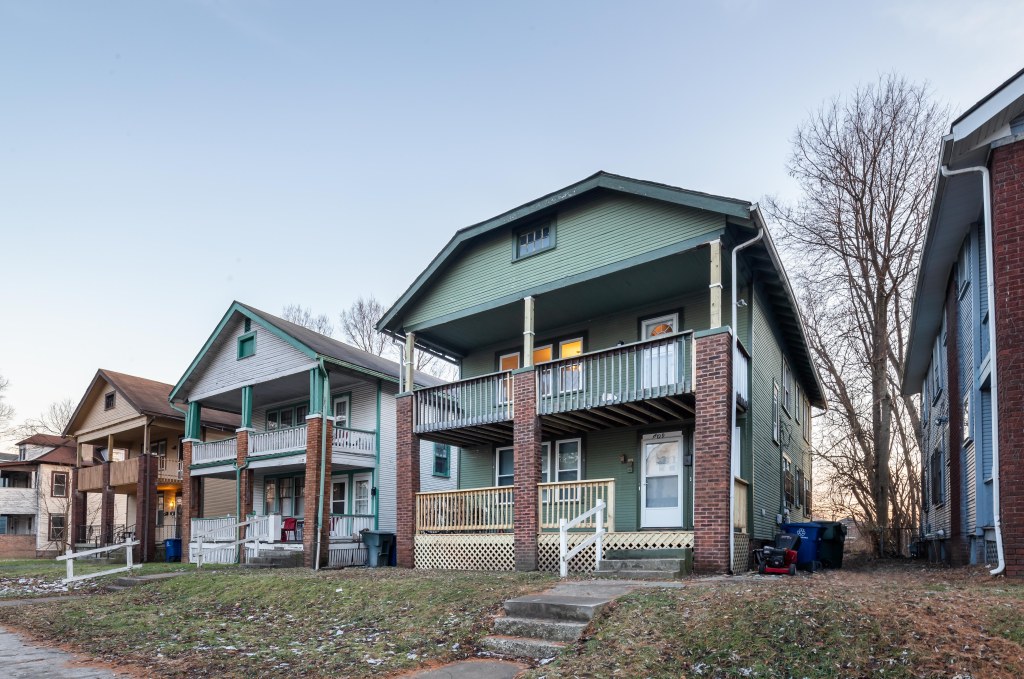
I bought a run-down duplex in Columbus, Ohio for $120,000. The property needed some serious cosmetic work, but structurally it was in good shape. $120,000 for this property was a good deal, and I loved the location as well. I researched the area and found several comparable properties nearby that had already been fixed up and recently sold for well over $225,000. I knew that once I renovated my property, it would be compared to those properties when it was time to refinance.

There were multiple offers on this property, but I made an offer over the asking price and won! To fund the deal, I borrowed the entire purchase price and most of the renovation cost from a private lender that I had pre-arranged to borrow from. The lender was a real estate investor I met through my networking efforts. I paid $500 up front to the lender, and 9% interest for the duration of the loan, which lasted about 6 months. The total cost of the loan ended up being approximately $7,500.

Step Two – Renovate

When I do projects like this, my goal is to have the total, all-in cost to purchase the property be less than 80% of the ARV. For this property, since we were using $225,000 as the ARV, we wanted to be all-in for under $180,000 ($225k times 80%). I knew the purchase price was $120,000, the loan expenses were $7,500, and I would have another $5,000 of miscellaneous expenses (closing costs, taxes and insurance during renovation, etc.), which put me at $132,500 prior to the rehab. So I knew I had a budget of $47,500 to get this project done at 80% of final value.

I walked through the property with my contractor prior to purchasing to get a budget for the renovation project, and we were targeting a $45,000 project cost all-in. We put in all new vinyl windows, installed new cabinets in the kitchens, updated the bathrooms, new interior paint, resurfaced the original hardwood flooring, and added new light fixtures throughout. The project took about 10 weeks total to complete. We ended up going slightly over budget and the project came in around $50,000.

Also – a quick note on the renovations. When I use the BRRRR strategy, I like to put higher end finishes in the property, which will help get the highest appraisal value when you refinance. For example, we put granite countertops in, do nice subway tile showers, etc.

Step Three – Rent

Once the renovation was finished I put both sides of the property up for rent and started showing it. After a few weeks I had rented both sides of the property out for a total of $1,900 in rent.

Step Four – Refinance

Prior to buying the property I was pre-approved for a loan with a local community bank for a cash out refinance on a rental property. The bank had a 6-month “seasoning” requirement, meaning that they would not offer a loan on the property at a higher value than what I paid for it until I had owned the property for at least 6 months. This is typical with most banks, so I typically can’t refinance until the 6 month anniversary of purchase. The bank agreed to loan me 80% of the appraised value after repairs, on a 30 year amortization, fixed for 5 years at 4.125% interest.

As I mentioned above, my goal with this project was to add enough value to the deal to pay off my private lender and not have any of my own cash left in the deal – essentially a free property. My total project cost ended up being about $182,500, all-in, including the purchase price, the renovation cost, the payments to my private lender, the closing costs on the refinance and other miscellaneous costs.

The appraisal came in at $235,000, meaning, based on this appraisal I added $52,500 in value to the property. The bank loaned me 80% of the appraised value, which was $188,000. This allowed me to repay my private lender, restock my own cash used for any expenses, and put an extra $5,500 in the bank!  And I get to keep the duplex.

Step Five – Repeat

Repeat as many times as possible and reap the rewards. I believe this is the best strategy to get started investing in real estate because it allows you to grow quickly without much money, and the rewards can be very good.

At the end of this project, I essentially got paid $5,500 to buy a duplex. I also added a little more than $50,000 in value to the property which I get to keep in the form of equity. The property also generates about $7,000 per year in cash flow after all expenses, shown below:

  • Monthly Rent Income
  • Monthly Debt Service
  • Monthly Tax
  • Monthly Insurance 
  • Monthly Reserves (maintenance, etc)
  • $1,900
  • $900
  • $100
  • $75
  • $250
  • Total Net Cash Flow                                   $575 per month ($6,900 per year)

The expenses above also include about $3,600 per year of debt that is paid off, adding to the overall benefits of the project.

I have used this process a number of times, just like this, and it really works. The process works on any size property too, from a single family house to a 100+ unit apartment building. Sometimes a project will go over budget, or the appraisal will come in low, but even if you don’t get all of your money back out of the deal, it is still a win to get almost all of it back. It is possible to get free rental properties!  It doesn’t get much better than that!

How I Became a Full-Time Real Estate Investor

I first decided that I wanted to invest in real estate during my senior year of college. I was a finance major and had recently studied the “Discounted Cash Flow Method” which basically allows you to value any asset based on the amount of cash flow it generates. One night after class I was sitting around with a few of my friends, drinking Natural Light beers and listening to Led Zeppelin. Apparently inspired by the cheap beer and guitar solos, I pulled out my laptop and started running valuation calculations on different things, including the college rental that I lived in at the time with 7 other guys. I asked my roommates how much they paid in rent each month, then ran a valuation of our house based on the rent. I remember thinking Holy Shit! – If I owned this place it would pay me more than a lot of the jobs I could get with my business degree.  The seed was planted.

It would be about 6 years before I took any action on my discovery. After college I went to law school and got a job as in-house counsel with a small but rapidly growing company. My company had an entrepreneurial environment, and I saw a great opportunity there. I started working my ass off trying to learn everything I could and climb the corporate ladder, and at age 29, I became the General Counsel and head of the legal department. Things were going well, and I really liked my job. I was constantly busy during this period and I kept telling myself, “one day I will buy a rental property”, but it seemed the time was never quite right.

Then in 2013, I finally bought my first investment property. Two weeks prior to the closing, my wife Kylie and I had our first child, and we had serious doubts about whether we should buy the property while we were learning how to be new parents. Once again, it seemed, the timing wasn’t quite right. But this time we decided to pull the trigger anyway, and we took our two-week-old son to the closing of our first investment property. I am so glad we didn’t wait!

After becoming a dad, I really wanted to be with my kids as much as I could while they were still little, and I started viewing my time through a different lens. A late night or a weekend workday never bothered me before, but now it meant that I would miss out on time with my kids, and I didn’t like it. I also had some great travel experiences with my family right around this time, and I began to think about how nice it would be to travel more often, something that is hard to do when you run a corporate legal department. I started to think about the real estate business in a bigger way, as a tool to replace my income so I could travel more and spend more time with my family.

As I started to think bigger about real estate, I learned that my Natural Light fueled epiphany back in college was just the tip of the iceberg of the full benefits that real estate investing can provide. Real estate spins off cash flow, it consistently appreciates in value, it has great tax benefits, and you can use other people’s money as leverage to grow. Once I saw this, I was changed forever, and I was going all-in on real estate.

I started building, but it was extremely slow and frustrating at first because I really didn’t know what I was doing, and I had no money. As it turns out, building a real estate portfolio is really hard, especially in the beginning. I have heard it described as a train getting started moving – a ton of energy at first with not much to show for it, but once you finally get going, your momentum carries you forward quickly without much additional energy required. This was my experience with real estate investing. Finally, I found a way to buy real estate that didn’t require much money, and started gaining momentum and I haven’t looked back from there.

As I write this article, a little over 7 years after purchasing my first property, Kylie and I now run the company as a team, and our business generates more income than Kylie and I made combined working as full-time professionals. We can run our business from anywhere, and it doesn’t require nearly the amount of time that our corporate jobs did, which means we can travel as much as we want, and we get to spend quality time with our two young kids during their formative years. It has also allowed me to have time to write this blog and pursue other interests that I wouldn’t otherwise have time for.

I love being a full time real estate investor. If you have ever thought about getting into real estate, my advice to you is to jump in. The time might never feel quite right, and you might just have to take the leap. One thing I know for sure is that if I can do this, anyone can do it. If you take the time to learn about real estate and build a solid foundation, save your money, and take action, you can become a full-time real estate investor too.